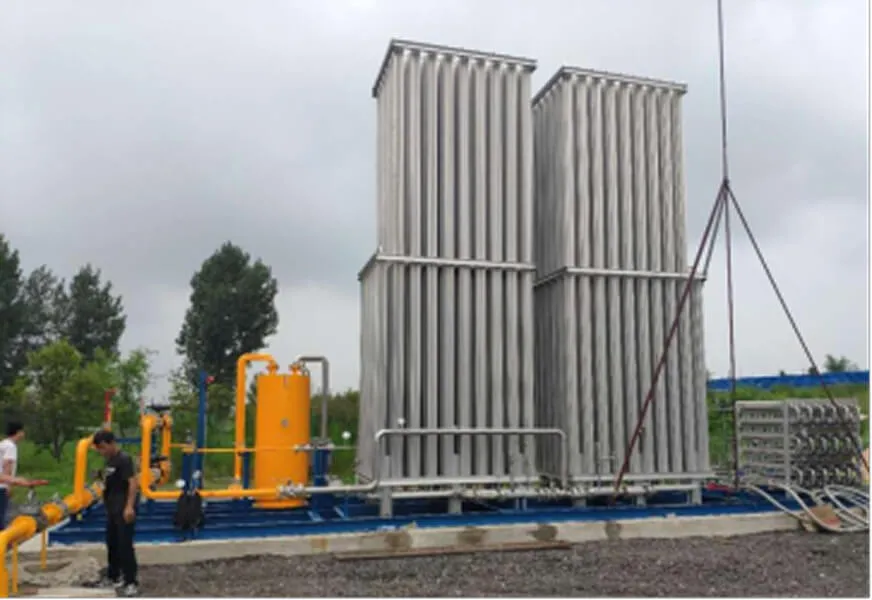
The vaporizer heat source decides most of what comes after it: footprint, utilities, how the unit behaves on a cold night, and what you do when something trips. Ambient air, an electrically heated water bath and steam all turn liquid LPG or LNG into gas, but they ask very different things of your site. This note walks through the three using the equipment we build and the projects behind it, so you can narrow the choice before anyone opens a datasheet.
Start with the heat, not the vaporizer
Liquefied gas has to absorb heat to boil. Where that heat comes from is the real design question. Patent literature on cryogenic regasification sorts vaporizers the same way: ambient air is the heating medium of an ambient air vaporizer, while water, or a water mixture that resists freezing, serves a water bath vaporizer. The water itself can be warmed by gas firing, electric heaters or steam. Steam-heated units follow the same logic with another supplier of heat.
So before you compare models, write down three things. How much gas do you need per hour? What does the site already have in the way of power, steam, hot water and open ground? And how cold does it actually get? Those answers usually rule out one or two options on their own.
Ambient air: free heat with conditions attached
Our air ambient vaporizer is built from low-temperature aluminum alloy and takes its heat from natural air convection. It needs no electricity, no steam and no fuel. There are no electric heating elements and no open flame, and the unit can stand outdoors. The published range is 50 to 1000 kg/h for LPG and 100 to 10,000 Nm³/h for other gases, with a design pressure of 1.6 MPa and an LPG working pressure of 0.04 to 0.07 MPa.
Installation is simple but not careless. The unit should sit in a well-ventilated area, mounted at least 200 mm above ground. For colder climates or high-demand duty there's an optional forced hot air system.
The catch is the weather. The same patent literature describes ambient units as low in equipment cost, simple, reliable and cheap to run, then lists the drawbacks: a large footprint because heat transfer is modest, extreme sensitivity to ambient conditions, and lost performance when ice forms on the tube surfaces. Put plainly, an ambient vaporizer is the right answer on an open, mild site and a questionable one where nights are cold and the air is damp. We'll come back to that frost problem in a separate note.
Electric water bath: steady heat from the grid
In an electric water bath vaporizer, heaters warm the water in a vessel. Liquefied gas runs through stainless steel coils immersed in that water, vaporizes and is superheated, and an integrated gas-liquid separator catches any entrained liquid. An automatic control system holds the bath temperature.
The protections matter as much as the heat. The unit carries a high and low water temperature alarm interlock, low water level protection, automatic shut-off of the inlet liquid valve and a safety valve against overpressure. And because the heat comes from the bath instead of the air, performance isn't affected by a low ambient temperature.
The size table for this model runs from 50 to 1000 kg/h, with heater power rising from 7 kW at the small end to 130 kW at the large end. Power draw is therefore the first thing to check against your supply. Our own guidance places the electric type where gasification volume is low, electricity is plentiful or no other heat source exists. A water bath vaporizer page covers a wider 50 to 3000 kg/h range, a design pressure up to 2.5 MPa and operation from -40 to +60 °C.
One real example: a 100 kg/h electric water bath LPG vaporizer skid in Saudi Arabia supplies ignition gas for a flare and boiler system at 0.8 MPa working pressure, outdoors in desert heat, under automatic temperature control. Ignition gas can't be allowed to stop, and the project notes credit the indirect water bath heating with uniform heating and steady vaporization.
Where a site already has a boiler or hot water, there's a third route inside the same family: a warm water circulation type that uses the existing hot water through a closed loop and cuts the extra energy needed.
Steam heated vaporizer: when the plant already has the heat
Steam heating comes in three forms on our LPG systems: steam direct heating, a steam water bath, and intermediate-medium indirect heating. They're meant for plants with a steam network and a high gasification volume. Our steam heated vaporizer page describes higher heating capacity, flexible operation and suitability for large-scale industrial gas supply compared with conventional electric or water bath units. Capacity is customized rather than picked from a table.
Two projects show the range. In India, a steam heated LPG vaporization system rated at 25,000 kg/h feeds a fuel gas pipeline network. And for a dimethyl carbonate purification plant, a 50 t/h steam-heated liquid CO2 vaporizer takes liquid in at 4.0 MPa and -35 °C and sends gas out at about 20 °C, with a heat duty of roughly 5,250 kW from circulating hot water backed by steam.
At that scale, steam is a plant-utility question before it's an equipment question. If the steam isn't there, the vaporizer can't make up for it.
The three side by side
| Heat source | What it needs on site | Where it fits | Watch for |
|---|---|---|---|
| Ambient air | Open, ventilated ground; no utilities | Outdoor LPG duty in the 50 to 1000 kg/h class, mild climates | Output follows the weather; ice on the tubes |
| Electric water bath | An electrical supply | Lower volumes, no other heat source, ignition gas | Heater power grows with capacity, from 7 to 130 kW |
| Steam | An existing steam supply | High gasification volume, plants with a steam network | Customized capacity; steam has to be available |
What happens when the heat source falters
Every heat source can fail, so ask how the unit behaves when it does. The patent background on water bath units is blunt about it: with the bath hot, ice around the tubes is negligible, but if the burner, the electricity or the steam is lost, the water cools, heat transfer drops, ice forms and the outlet vapor temperature falls. That matters because the pipe to the end user is typically carbon steel, which can turn brittle in the cold, and piping standards set a minimum design temperature for it.
Designers answer with extra thermal mass or with protective trips. The electric units above close the inlet liquid valve automatically, which is the sort of interlock worth asking about whatever your heat source. An ambient unit loses performance differently: gradually, as ice builds on the tubes, instead of with a sudden loss of power.
What to bring to a sizing conversation
You don't need a finished design. You need a handful of facts, and our engineers can take it from there:
- Gas type: LPG, propane, butane, LNG or another liquefied gas
- Consumption rate, in kg/h or Nm³/h
- Inlet conditions, outlet pressure and working pressure
- Operating temperature and the lowest ambient temperature
- Application, for example boiler fuel, ignition gas or pipeline supply
- Project location, and which utilities are on site: power, steam, hot water
Browse the full vaporizer range to see how the models line up, or send your conditions through the contact page and we'll suggest a configuration.
FAQ
What are the main types of vaporizers for LPG and LNG?
They are grouped by heat source. Ambient air vaporizers use the surrounding air, water bath vaporizers use heated water, and steam-heated vaporizers use plant steam. The water in a bath can itself be heated electrically, by gas firing or by steam.
Can an ambient air vaporizer work in a cold climate?
It can, with care. Output depends on the weather, and ice forming on the tube surfaces reduces performance. Our ambient unit offers an optional forced hot air system for colder climates or high-demand conditions, and a water bath or steam unit is the alternative when winters are harsh.
When does a steam-heated vaporizer make sense?
When the plant already has steam and the gasification volume is high. Projects such as a 25,000 kg/h LPG system and a 50 t/h liquid CO2 vaporizer use steam because the heat duty is large and the utility is on site.
What information do you need to size a vaporizer?
Gas type, consumption rate, working pressure, operating temperature, application and project location, plus the utilities available. With those, an engineer can recommend a heat source and capacity.